


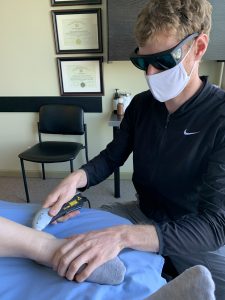
Meet BodaHealth team member and Exercise Physiologist, Chris Munn! Chris incorporates movement, prescribed exercises, massage, Yoga, Pilates, therapeutic personal training, and cold laser therapy to treat and prevent a wide variety of health conditions. He also brings mindfulness, meditation, breathing, and education into his treatments. Read on to learn more about Chris!
Jeda Boughton (JB): Hi Chris, thank you for agreeing to do this interview! It’s awesome to finally have you in Vancouver, all the way from Australia! How are you enjoying British Columbia so far?
Chris Munn (CM): Hi Jeda! Thank you, it’s lovely to be here. I’ve been dreaming of visiting Canada for a long time. Having the mountains so close by definitely drew me to Vancouver. With covid restrictions limiting what we can do, I’ve been taking the opportunity to take some small hikes near North Vancouver and in the next few months, I may try to get a bit more adventurous and do some longer hikes.
JB: In Canada, I don’t think we have the designation Exercise Physiologist. As someone who practices Exercise Physiology, how would you compare it to modalities that are practiced in Canada? What is the most similar training that we have in Canada?
CM: Exercise Physiology (EP) is way bigger in Australia, but we don’t have very many Kinesiologists at all in Australia. Luckily the government and insurance companies support many programs for EP treatment because there’s a lot of scientific evidence to show that correctly prescribed exercise can be more effective for a lot of conditions than any drug that may be prescribed and without the negative side effects. There are some Exercise Physiologists in Canada though, and I’ve completed registration with the Canadian Society of Exercise Physiology. It seems that most EPs in Canada work in research at Universities, cardiac rehab clinics or hospitals.
My training is quite similar to a Kinesiology degree in Canada. I would guess that my training is a little bit broader in the conditions that we’re able to treat using exercise, compared to a Kinesiologist. To register, we need to prove sufficient experience working with individuals who have conditions that fall into categories such as cardiovascular, musculoskeletal, neurological, cancer, respiratory, mental and other conditions.
When I explain EP, I usually say that it’s similar to physiotherapy, but with less diagnostics and less hands-on, but more specialized in exercise prescription for a broader range of conditions.
JB: The whole team at BodaHealth is really excited to have you on board to help take our patient care to the next level. You have so many tools in your repertoire with exercise physiology, yoga, massage therapy, Pilates, and now cold laser therapy, can you describe the types of patients and conditions you mainly work with?
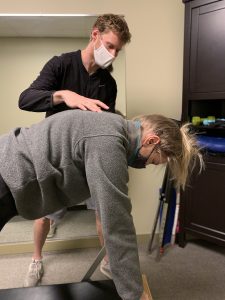
CM: I enjoy treating clients with musculoskeletal conditions because I’m able to use laser therapy or massage to relieve pain combined with appropriate exercise to further rehabilitate and reduce the chance of reaggravation.
Having said that, I also enjoy treating a broad range of clients for mental health, cardiovascular conditions, diabetes, fall prevention and cancer.
JB: I didn’t realize you worked with cancer patients. What kind of patients do you normally work with? Are you treating elite athletes or people who have difficulty doing their day-to-day tasks? For example, what can you do for patients who have or have had cancer? Would you work with someone who just had a recent stroke?
CM: Exercise is beneficial in preventing and slowing the progression of most cancers. Hopefully, those undergoing chemotherapy would see some form of exercise specialist as part of their treatment. The cancer patients I’ve had the most experience with are those undergoing therapy for prostate cancer. The medication lowers clients’ testosterone, which if not managed appropriately has side effects of reduced bone density, muscle wasting, increased trunk fat and poor blood flow regulation which can lead to hot flashes. These changes increase the risk for soft tissue injuries, cardiovascular diseases, diabetes and osteoporosis. Luckily, an appropriate exercise prescription is beneficial for all of those things!
I’ve found that most doctors refer clients to Exercise Physiologists for long-term or chronic health issues like pain related to arthritis or injuries, but on assessment, we almost always find that we’ll also be treating other conditions or comorbidities.
Soon after I completed my remedial massage diploma, I had the chance to work with some runners who had attended Olympic Games, and more recently some international level triathletes, swimmers and gymnasts. I enjoy working with them because they want to be the best they can, so they really want to follow best practice advice, which means you see results. Also, my personal experience with health issues have often been sport-related, which makes therapeutic exercise personally interesting for me.
With something like a stroke, my hope is that the patient would have been immediately prescribed exercises from day one in the hospital, as well as ongoing care provided for three months following. So, yes absolutely, I’m able to work with people who’ve had a stroke at any point in their recovery.
JB: What sparked your interest in health care and how did you become interested in exercise therapy and massage therapy?
CM: My dad was a volunteer masseur and sports trainer at some of my sisters’ and my sporting clubs. I found what he was doing to be more interesting than his day job as a mechanic!
All through school I was the sporty kid. In high school, I was getting serious about long-distance running and had to deal with injuries every year.
During that time I had experience with a range of health professionals. In particular, I felt that I benefited most from massage in helping me return to training, but other aspects of health and fitness also interested me. I considered becoming a physiotherapist, but the bachelors in Exercise and Sport Science seemed to interest me more because they were more holistic and covered diet and exercise in more depth.
JB: That’s pretty awesome that your dad was so involved and able to enhance your athletic performance with massage. How did you learn about exercise physiology, did you know someone who practiced it?
CM: While I was studying for my bachelor’s degree I first heard about exercise physiology as a profession. I saw that combining massage and exercise physiology would be an ideal way for me to prevent my own injuries and to work with people to recover from injuries similar to those I had been dealing with.
JB: Did you study massage before or after exercise physiology?
CM: I completed my diploma in Remedial Massage the year following my bachelor’s and then started post-graduate studies in Exercise Physiology. Although treating musculoskeletal conditions was my main interest during my post-graduate studies, I became very interested in the scientific evidence that found how effective specifically prescribed exercise can be for the prevention and recovery from conditions such as diabetes, cancer or dementia, and how early exercise interventions can be highly beneficial for people who’ve just had a stroke or heart attack.
JB: Did your dad encourage you to go into healthcare?
CM: In high school, I mentioned to my dad that I was interested in personal training, but he discouraged me from pursuing that straight out of school. However, studying to work in healthcare was definitely an option that was supported by my family because they believe there will always be jobs in healthcare and it’s still a growing field.
JB: In addition to being a massage therapist and exercise physiologist, how does your other training and skills fit in with your practice? What conditions are best treated by them, and what’s your philosophy on any of the techniques you use?
CM: I’ve completed coaching courses for swimming, gymnastics, athletics in order to better treat people in those sports and as a way to learn additional exercise treatments.
I also took a two-week traditional Thai massage (on the floor) course in Thailand. This broadened my massage skills a lot. I found it particularly useful for treating clients without needing to use oil because it can be done fully clothed.
Also in Thailand, I took a 200 hour Yoga Teacher course. What I found most useful from this course when working with my clients wasn’t so much the poses; it was more the introduction to yoga as a broader practice for overall health through practicing mindfulness, different forms of meditation, breathing techniques for different purposes, and also ways to adapt yoga poses for my clients.
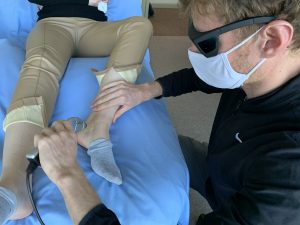
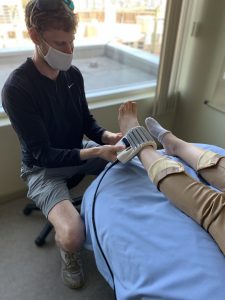
This year I completed the Bioflex cold laser therapy certification for treating clients here at BodaHealth. I’m also training in reformer Pilates, with Balance Body, which will also be available at BodaHealth.
JB: That is amazing that you are trained in Thai massage. I love the combination of Thai massage and yoga. Do you ever practice Thai massage as a full treatment or implement some of the movements?
CM: That’s an interesting point about the Thai massage and yoga combination. A lot of the massage stretches place your body into similar positions that your body goes into during yoga poses. It has some similarities to yin yoga where your nervous system is as relaxed as possible while doing some form of stretch. Usually, I incorporate a couple of Thai massage moves into my massage routine. Thai massage techniques can be performed fully clothed which makes it easy to incorporate during an exercise physiology appointment too.
JB: I can tell that you’re very fit; what kinds of things do you do for yourself to stay fit and healthy?
CM: I like to do lots of things! Now that I’m no longer competitive in endurance sports, I try to be a lot more balanced with the types of exercise I do.
I do self-myofascial release exercises and self-massage to improve posture and prevent the onset of muscle aches and pains. As part of my week, I try to do a form of exercise where I am learning something new.
Learning new things is good for brain health. I’ve previously learned juggling, some basics in Olympic weightlifting which is very technical, some dance classes in Latin styles and contemporary dance, which I’m not necessarily good at but it was fun to learn some beginner-level moves. Just before I came to Canada I was also learning some basic aerial skills in Lyra which is like a hoola hoop attached to the ceiling and silks which is like two curtains. In Canada, there are more restrictions due to COVID19, but I’m still doing some exercise for strength, balance, flexibility and endurance from yoga, Pilates and getting outdoors for hiking.
I’m also interested in the Wim Hof method which involves meditation, cold exposure and breathing practice. There are many beautiful places near Vancouver where I can go for a hike and swim in the cold water, which I’m trying to do as well.
JB: Wow! Those all sound like so much fun. I think you moved to the right city; B.C. has no limit for places you can find cold water! You mentioned your degree in Exercise & Sport Science being holistic and covering diet and nutrition in-depth as well, do you incorporate this into your lifestyle?
CM: Apart from exercise, I try to maintain consistent sleeping habits and my diet involves trying to eat lots of whole foods. My diet differs from the normal healthy eating guidelines in that I try to consume more of certain kinds of fats than is typically recommended and I try to do some intermittent fasting a couple of days each week, but I think the most important thing is to avoid eating too much highly processed foods and have variety in your diet.
JB: You already have so many skill sets and roles, and you’re constantly adding more. What’s next for you professionally? Since you, Jennifer and I have been taking the Pilates Reformer training course, I’ve been able to see first-hand how passionate and knowledgeable you are about the human body and how it moves. Are you planning on doing additional studies or courses or do you want to evolve in a particular area with your practice? What do you see for your next few years?
CM: I’m excited to have access to a Pilates reformer in the clinic, so I plan to complete the reformer series 2 and 3 when the courses are available.
Also, the field of pain management has focused a lot of research on understanding pain physiology and in explaining pain physiology to people suffering from chronic pain as a way to help with rehabilitation. I can see that upskilling in this area would be beneficial for both my massage and exercise clients.
JB: I’m impressed with your motivation to learn and grow as a practitioner and a human being! On a closing note, is there anything else you’d like to tell people if they’re looking for an exercise physiologist or massage therapist, if they’re dealing with an injury or if they’re just curious about what you do or anything else we talked about?
CM: Most of us know that we can feel better immediately after exercise or massage, but many of the benefits (or what we call chronic adaptations) are achieved through consistency. When you start performing rehabilitation exercises, you may not see as much immediate improvement in your condition as you’d hope, or in the case of people undergoing chemotherapy, they can initially feel worse. But with the right treatment from a therapist which may include prescribing independent self-massage or exercises to be performed regularly, your health will improve and your resilience to health conditions will become stronger.
JB: This has been great, thank you Chris!
Chris Munn completed his bachelor’s degree in Exercise and Sport Science, and Post Graduate Diploma in Clinical Exercise Science at the University of South Australia. He also has a Diploma in Remedial Massage at the Australian College of Massage. Chris treats a number of health conditions using exercise as therapy, massage, and a wide variety of other techniques.
Click here for a free 15-minute consultation!


